


Bylaws

Download PDF of SONC Bylaws

SHERMAN OAKS NEIGHBORHOOD COUNCIL
(SONC)
BY-LAWS
 
[AS AMENDED EFFECTIVE SEPTEMBER 1, 2008]

                                                                                                                                                                              ARTICLE I

NAME
The name of this organization shall be SHERMAN OAKS NEIGHBORHOOD COUNCIL (sometimes referred to as the “Council” or “SONC”).
                                                                                                                                                                            ARTICLE II

MISSION STATEMENT
The mission of the Sherman Oaks Neighborhood Council shall be:
A.                  To engage the broad spectrum of Sherman Oaks community Stakeholders for collaboration and deliberation on matters affecting the community including events, issues and projects.
B.                  To work to achieve the objectives or projects that the Council desires to support,
C.                  To monitor and promote the delivery of City services within Sherman Oaks,
D.                  To promote Sherman Oaks community Stakeholder participation and advocacy in City government decision-making processes and to promote greater awareness of and achieve maximum utilization of available resources,
E.                   To be an advocate for the Sherman Oaks community to government and private agencies.
F.                   To present to the Mayor and the City Council a list of Council priorities for the City budget as per LAAC ordinance 11172728 section 1, div. 22.
G.                  To take any other action that is, or may be, authorized for neighborhood councils of the City of Los Angeles.
                                                                                                                                                                          ARTICLE III

DISTRICT BOUNDARIES
The boundaries of the community represented by the Sherman Oaks Neighborhood Council are as follows:
1.                   Burbank Boulevard on the north*
2.                   Coldwater Canyon Avenue on the east*
3.                   Mulholland Drive on the south
4.                   The 405 Freeway on the west
                                                                                                                                                                           ARTICLE IV

CODE OF ETHICS
SECTION 1:            NON-DISCRIMINATION:
The Council will encourage all Stakeholders to participate in its activities, and will not discriminate against individuals or groups on the basis of race, religion, color, creed, national origin, ancestry, sex, sexual orientation, age, disability, marital status, income, citizenship status, or political affiliation in any of its policies.
SECTION 2:            CONFLICT OF INTEREST AND APPLICABLE LAWS:
The Council shall be subject to any or all applicable sections of federal, state and local laws, as well as the City of Los Angeles Government Ethics Ordinance (Los Angeles Municipal Code Section 49.5.1).
SECTION 3:            RESTRICTION ON POLITICAL CAMPAIGNS:
The Council shall not participate in, or interfere in (including the publishing or distribution of statements), any political campaign on behalf of any candidate for public office, by election or appointment. This restriction shall not be interpreted to forbid informational events such as candidate forums. This restriction shall not prevent the Council from taking a position on legislative action, ballot initiatives, ballot measures, Los Angeles City Council Agenda items, or other such similar administrative or legislative action items. 
                                                                                                                                                                             ARTICLE V

STAKEHOLDERS
SECTION 1:            DEFINITION:
Membership is open to all “Stakeholders.” A “Stakeholder” is defined as any of the following:
A.            Residential Stakeholder: A Residential Stakeholder is any person who lives or whose residence is in an area defined in Appendix “A.”
B.            Business Stakeholder: A “Business Stakeholder” is any person who works for, manages or owns a business in an area defined in Appendix “A.”
C.            Community Interest Stakeholder: A “Community Interest Stakeholder” is any person who identifies himself/herself as a Stakeholder not solely because of their residential or business status. “Community Interest Stakeholders” include but are not limited to those who volunteer for, participate in, or are affiliated with, educational institutions, religious institutions, community organizations or non-profit organizations based in an area defined in Appendix “A,” and also to those who declare a stake in such an area and affirm the factual basis for it.  
                                                                                                                                                                           ARTICLE VI

MAKEUP OF THE COUNCIL
This Article explains the administration of Neighborhood Council elections by the City Clerk and provides information regarding Stakeholder membership, the board’s structure, and Stakeholder eligibility for voting and being elected or appointed to a board seat. The provisions in this Article supersede any prior inconsistent provisions contained in these Bylaws.
SECTION 1:            COUNCIL COMPOSITION:
The Council shall be comprised of up to twenty-one (21) elected or appointed “Members,” from each of the following three Stakeholder groups identified in Article V, as follows:
A.                  Residential Stakeholder Members (RSM): An RSM shall be any person who lives or whose residence is in an area defined in Appendix “A.” One RSM may be elected in each of the seven (7) designated areas listed in Appendix “A.”
B.                  Business Stakeholder Member (BSM): A BSM shall be any person who works for or owns a business in an area defined in Appendix A. One BSM may be elected in each of the seven (7) areas designated in Appendix “A.” 
C.                  Community Interest Stakeholder Member (CSM): A CSM shall be any person who identifies himself/herself as a Stakeholder as defined in Article V not solely because of their residential or business status. CSM stakeholders include but are not limited to those who volunteer for, participate in, or are affiliated with, educational institutions, religious institutions, community organizations or non-profit organizations based in Sherman Oaks and also to those who declare a stake in the neighborhood and affirm the factual basis for it. CSMs shall not be solely based on membership in a homeowners or business related organization. One CSM may be elected in each of the seven (7) areas designated in Appendix “A.”
In accordance with the Plan for a Citywide System of Neighborhood Councils (“The Plan”), the Council must, to the extent possible, reflect the diversity of the Neighborhood Council’s Stakeholders. Accordingly, no single Stakeholder group shall comprise a majority of the Council unless warranted by extenuating circumstances and approved by DONE. To serve on the Council by election or by appointment, a Member must be a minimum age of 18 years at the time of the election or appointment.
SECTION 2:            ELECTION, REMOVAL AND APPOINTMENT OF MEMBERS
A.                  Election: The Council shall move its elections to the City Clerk in 2010. During the transition period of moving elections to the City Clerk, the Council shall not hold any other elections. In order to provide continuity on the Council, the Council is to establish a staggered election system where approximately half of the Members are elected at each City Clerk conducted election. Beginning with the City Clerk conducted election in April - June 2010, every Council position shall be open for election, at which time Members from the following areas shall be elected for a duration of two years or until a successor is elected or appointed: Areas #1, #3, #5 and #7. The remaining Members, in Areas #2, #4 and #6, shall be elected for a duration of four years or until a successor is elected or appointed. Beginning with the City Clerk conducted election held in April – June 2012, and each election thereafter, each and every Member shall be elected for a four-year term, or until a successor is elected or appointed.
B.                  Term of Office: Each Member shall serve for a term of four (4) years. Newly elected Members will be seated after confirmation of the final election results, or in the event of a recount or election challenge, after confirmation of the results of that recount or election challenge, in which case incumbent Members will continue in their positions until any recount or election challenge is resolved. During the transition period of moving elections to the City Clerk, the current Members shall extend their terms of office to the date when the newly elected Members of the City Clerk conducted election in April – June 2010 are seated.
C.                  Stakeholder Voting: To be eligible to vote in an election, a Stakeholder must be a minimum age of 18 years at the time of the election. Each Stakeholder shall select one of the seven (7) geographic areas, based on stakeholder status, as stated in Article V, in which he/she will cast his/her vote for an RSM, BSM, and CSM to represent that geographic area. A Stakeholder’s selection of his or her geographic choice shall be recorded through such reasonable voter registration process as the Council may select in accordance with applicable election rules and regulations.   Once a Stakeholder registers for a particular geographic area, he or she may not vote for candidates in any other geographic area unless there has been a material change in the Stakeholder’s geographic status such that the Stakeholder no longer defines himself or herself as a Stakeholder in the geographic region in which he or she last voted (e.g., a change of residence). 
D.                  Removal: Members may be removed or replaced for the following reasons:
1.                   Absences: A Member shall be permitted a maximum number of four absences per “Council Year” (for purposes of this provision a “Council Year” begins with the first scheduled Council meeting following the Member’s election or appointment and continuing for the next eleven months thereafter). Upon occurrence of the fifth absence, the Member shall be removed from the Council. The Member may seek reinstatement through the grievance procedure provided in Article XII.
2.                   Change or Loss of Stakeholder Status: A Member who is no longer a Stakeholder in the capacity for which they were elected or appointed, as defined in Article 6, Section 1, shall be automatically removed as a Member. It is the responsibility of each Member to notify the President of any change of stakeholder status within 30 days of such change.
3.                   Resignation By Member: Members may resign by submitting a written letter of resignation to the President. In the sole discretion of the President, a letter of resignation may be immediately accepted.
4.                   Removal by Council Action: A Member may be removed by the submission of a written petition which 1) identifies the Member to be removed, 2) describes in detail the reason for removal, and 3) includes the signatures of 100 Stakeholders from the geographic area represented by the Member. The Secretary shall then have the matter placed on the agenda for a hearing by the Council at the next regular Council meeting pursuant to the procedure set forth below:
(1)                 The Member shall be given a minimum of fifteen (15) days’ prior notice of the proposed removal and the reasons for the proposed removal. Any Notice given by mail shall be sent by first class and registered mail to the Member’s last known address.
(2)                 The Member shall be given an opportunity to be heard, either orally or in writing. The hearing shall be held, or the written statement considered, before the Council. 
(3)                 The Council shall decide whether or not the Member should be removed. Any removal of a Member pursuant to this subsection shall require an affirmative vote of two-thirds (2/3) of the Council Members present and voting, including the vote of the Member being considered for removal.
The Council may consult with its legal counsel, the Offices of the City Attorney, throughout this removal process.
E.                   Appointment: In the event of a Member vacancy (whether resulting from the resignation or removal of a Member or the absence of any candidates for election), the President may appoint a qualified Stakeholder as a Member for the vacant position, subject to approval by a majority vote of Council members present and voting at the time approval for the appointment is requested.
SECTION 3:            MULTIPLE MEMBERSHIP:
Each Member may represent only one geographic Stakeholder group at a time. No person may serve as a Member while simultaneously holding elected office in the Los Angeles City government.
                                                                                                                                                                         ARTICLE VII

OFFICERS OF THE COUNCIL
(EXECUTIVE COMMITTEE)
SECTION 1:            OFFICERS:
The Officers of the Council (“the Officers”) shall consist of a President, a First Vice-President, a Second Vice-President, a Treasurer, and a Secretary. The Officers shall be elected by the Council as delineated in Section 2 of this Article. All Officers must be Members of the Council.
SECTION 2:            ELECTION OF OFFICERS:
1.                   Officers shall be elected annually for a one-year term by the Council at the first meeting following an election for Members. Newly elected officers shall take office immediately upon election.
2.                   If there are more than two candidates for an office and none receives a majority of the votes on the first election, a run-off election shall be held immediately between the two candidates receiving the highest number of votes.
3.                   In the event of a permanent vacancy in the office of President, the First Vice-President shall become the President for the remainder of the current term. In the event of a permanent vacancy in the office of First Vice-President, Second Vice-President, Treasurer or Secretary, the presiding officer shall nominate a replacement that shall be seated after approval by a majority of Council Members present. The replacement shall serve the remaining portion of the term of the office being filled.
SECTION 3:            RESPONSIBILITIES OF OFFICERS:
A.                  President: The President shall be the principal officer of the Council and shall be the presiding officer at meetings of the Council and shall exercise and perform such other duties as the Council may assign from time to time or as the Bylaws may prescribe.
B.                  First Vice-President: The First Vice-President shall act as a presiding officer in the absence of the President and, in case of vacancy in the office of President, or in the case of the President’s unavailability due to sickness, disability, death, or resignation, then the First Vice-President shall perform the duties of the President and when so acting shall have all the powers and perform such other duties as the Council or the Bylaws may prescribe. The First Vice-President shall be responsible for the oversight of all Council committees. The First Vice-President shall perform all other duties as the President or the Council may assign from time to time.
C.                  Second Vice-President: The Second Vice-President shall act as a presiding officer in the absence of the President and the First Vice-President and, in case of vacancy in the office of President and the First Vice-President, or in the case of the unavailability of both the President and the First Vice-President due to sickness, disability, death, or resignation, then the Second Vice-President shall perform the duties of the President and when so acting shall have all the powers and perform such other duties as the Council or the Bylaws may prescribe. The Second Vice-President shall ensure the meetings are undertaken in an expeditious manner and shall be the timekeeper, ensuring that all speakers speak within the required time frames. The Second Vice-President shall oversee elections and shall chair any election committee that the President may be requested to form on an ad hoc basis to aid in an election. The Second Vice-President shall perform all other duties as the President or the Council may assign from time to time.
D.                  Secretary: The Secretary shall keep the minutes of the Council; see that all notices are given in accordance with the provisions of these Bylaws; be custodian of the records of the Council; perform all other duties as requested by the President and/or the Council. The Secretary shall keep the Bylaws and Standing Rules up to date and shall keep an official list of all Members and committee members and their terms, and keep a register of the addresses (including electronic address, if applicable) and telephone numbers of each Member. The President may appoint an Assistant Secretary to assist the Secretary with all duties and act in his or her absence.
E.                   Treasurer: The Treasurer shall keep the books and maintain, or cause to be kept and maintained, adequate and correct books and records of transactions of the Council. The books and records, including books of accounts, shall be open to inspection by any Member or Stakeholders at all reasonable times. All books of accounts shall be kept in accordance with Generally Accepted Accounting Principles (“GAAP”).
                                                                                                                                                                       ARTICLE VIII

COUNCIL MEETINGS
SECTION 1:            MEETING PROCEDURES:
The Council may hold as many meetings as it desires, but shall hold meetings at a minimum of once per calendar quarter. All Council meetings, including general meetings, Executive Committee meetings and committee meetings, shall be governed by Robert’s Rules of Order or such other rules as the Council adopts insofar as such rules are not inconsistent with these Bylaws or with the law.
SECTION 2:            BROWN ACT REQUIREMENTS:
The Council and its Officers shall abide by all California statutes, including the Brown Act (the “Act”) relative to public meetings and public records. Those meetings defined by the Act as open and public shall allow Stakeholders and the public the opportunity to speak. 
SECTION 3:            NOTICES:
All public meetings, as defined by the Act, will be publicized within the Sherman Oaks boundaries in accordance with the Act, local and state law, and with Section 4 of this Article. The notice will specify the time and place at which the meeting will be held, and an agenda containing a brief description of all the items of business to be discussed at the meeting. The notice and agenda may be contained in a single document. Failure to receive a meeting notice does not invalidate the meeting. However, the provisions of the Act and these Sections must be compiled with in good faith.
SECTION 4:            POSTING AND MAILING AGENDAS:
All posting shall be made in accordance with the Act. Notification of all meetings, as defined by the Act, shall include posting at a minimum of five (5) public locations, as indicated on the public posting log filed with the Council’s application for certification as a Neighborhood Council. In addition, posting shall be made on the SONC Web site and delivered to any newspaper requesting a copy at least 72 hours in advance of the meeting, except when a special meeting is called in which case the agenda will be posted at the above described at least 24 hours in advance of the special meeting.
SECTION 5:            MINUTES:
Within seven (7) business days following each regular Council meeting, or as the Council otherwise directs, minutes of the meeting shall be sent by mail, fax or electronic mail to all Members and such others in the community as the Council directs.
SECTION 6:            RECONSIDERATION:
The Council may reconsider and amend its action on items listed on the agenda if that reconsideration takes place immediately following the original action or at the next regular Council meeting. The Council, on either of those two days, may entertain a motion for reconsideration which, if approved, shall result in the Council hearing the matter and possibly taking action. If the motion to reconsider an action is to be scheduled at the next meeting following the original action, then two items shall be placed on the agenda for that meeting: (1) a motion for reconsideration on the described matter and (2) a proposed action should the motion to reconsider be approved. A Member who previously voted with the prevailing side against the original action may make a motion for reconsideration. If a motion for reconsideration is not made on the date the action was taken, then a Member on the prevailing side of the action must submit a memorandum to the Secretary identifying the matter to be reconsidered and a brief description of the reason(s) for requesting reconsideration at the next regular meeting. 
                                                                                                                                                                          ARTICLE IX

COMMITTEES
SECTION 1:            COMMITTEES:
The Council may have both standing and ad hoc committees.
A.                  Standing Committees: Standing committees are listed in Section 6.
B.                  Ad hoc Committees: Ad hoc committees shall be formed as necessary at the discretion of the President, subject to approval by the Executive Committee.
C.                  All committees, with the exception of the Executive Committee, shall be overseen by the First Vice-President.
D.                  The function of all committees, with the exception of the Executive Committee, is to investigate and explore issues raised by Stakeholders, the Council or the President, and to report to the Council with their findings and to make recommendations as appropriate. Committees shall take independent action only when charged to do so by the Council or otherwise specifically authorized to do so by these Bylaws.
SECTION 2:            COMMITTEE CHAIRS:
With the exception of the Executive Committee, committee chairpersons or co-chairpersons shall be appointed by the President, subject to approval by the Executive Committee. 
SECTION 3:            COMMITTEE MEMBERS:
Each committee must have at least three committee members, including the committee chairperson or co-chairperson. All committee members must be Stakeholders. With the exception of the Executive Committee, at least one member of each committee should be a Stakeholder who is not an elected Member of the Council. With the exception of the Executive Committee, committee members shall be appointed by the committee chairperson or co-chairpersons and the President, subject to approval by the Executive Committee.   
SECTION 4:            TERM OF OFFICE:
Once appointed, each committee member shall serve a one year term, subject to reappointment, unless the committee is terminated sooner, or unless the member is removed from the committee following the removal procedures set forth in Article VI, Section 2.D of these Bylaws.
SECTION 5:            VACANCIES:
Vacancies on any committee may be filled by appointment made by the committee chairperson or co-chairpersons and the President, subject to approval by the Executive Committee.
SECTION 6:            STANDING COMMITTEES:
The Council shall have the following standing committees:
A.                  Executive Committee
B.                  Finance Committee
C.                  Community Outreach Committee
D.                  Land Use and Planning Committee
SECTION 7:            STANDING COMMITTEE COMPOSITION AND FUNCTION:
A.                  Executive Committee: The President shall be the chairperson of this committee. The Executive Committee shall consist of the Council officers and two Council Members appointed each month on a rotating basis. At least four (4) members of the Executive Committee shall be present to conduct an Executive Committee meeting. The President shall set the agenda for Executive Committee and for Council meetings, with input from the Executive Committee. The Executive Committee shall act as administrative body for the Council. It shall recommend actions to the Council. The Executive Committee shall also have the authority of the Council to make decisions on emergency and routine business items, and shall report all such actions and decisions to the Council, which may modify or reverse such actions or decisions upon a majority decision.
B.                  Finance Committee: The Treasurer shall be the chairperson of this committee. This committee oversees and administers all Council financial matters, including a system of financial accountability as required by the Department of Neighborhood Empowerment (“DONE”).
C.                  Community Outreach Committee: The chairperson for this committee shall be a Member, unless the committee is co-chaired, in which case one co-chairperson shall be a Member and the other may be a Stakeholder who is not a Member. This committee oversees the effectiveness of the Council’s communications with Stakeholders and is responsible for developing ways to increase Stakeholder participation in Council meetings and activities.
D.                  Land Use and Planning Committee: The chairperson for this committee shall be a Member, unless the committee is co-chaired, in which case one co-chairperson shall be a Member and the other may be a Stakeholder who is not a Member. This committee shall receive and review public input, report on and make action recommendations to the Council on any land use and planning issues affecting the Sherman Oaks community.
                                                                                                                                                                            ARTICLE X

QUORUM AND VOTING
SECTION 1:            QUORUM:
A quorum of the Council must be present to conduct general Council meetings. A quorum shall consist of 11 Members.
SECTION 2:            VOTING:
In order for the Council to take action, a majority vote of Council Members present and voting is required.
a.                   The presiding officer may vote on all motions
b.                   Voting by proxy shall not be allowed.
c.                    A majority is determined only by affirmative and negative votes.
                                                                                                                                                                          ARTICLE XI

AMENDMENTS
The Executive Committee may make a proposal for amendment of, change, addition and/or deletion to the Bylaws (an “Amendment”) by placing the Amendment proposal on the agenda for public discussion for two consecutive Council meetings. An Amendment proposal may also be made by any Member at any Council meeting or by any Stakeholder during the public comment period of any Council meeting; any such proposal, however, must then be formalized in writing and filed with the Secretary or person responsible for preparing the agenda for the next two consecutive Council meetings. 
In order to become effective, an Amendment proposal requires an affirmative vote of two-thirds of Council Members present and voting at two consecutive Council meetings. Thereafter, and within fourteen (14) days after an affirmative vote, an Application to Change or Adjust Bylaws, or such other form as may be prescribed, shall be submitted to DONE along with a copy of the existing Bylaws for review and approval by DONE all in accordance with Article VI, Section 3 of the Plan.
No Amendment shall operate to alter the eligibility of any Member to serve on the Council for the remainder of that Member’s term in which the Amendment is approved.  
                                                                                                                                                                        ARTICLE XII

GRIEVANCE PROCEDURE
SECTION 1:            ELIGIBILITY TO GRIEVE:
Any person or group who objects to a decision or policy or believes that they are adversely affected by a decision or policy of the Council may file a complaint in writing with the President. The Council shall resolve the complaint or take appropriate action and advise the complainant of the outcome. This formal grievance process is not intended to apply to Stakeholders who simply disagree with a position or action taken by the Council. Those grievances can be aired at Council meetings. This grievance process is intended to address matters involving procedural disputes (e.g., the Council’s failure to comply with Council Rules or these Bylaws) or its failure to comply with the City’s Charter, the Plan, local ordinances (and amendments) and/or State and federal law.
In the event that a grievance cannot be resolved through this grievance process, then matter may be referred to DONE for consideration or dispute resolution in accordance with the Plan.
SECTION 2:            COMPLAINT RECEIPT:
Within ten (10) days of receipt of the complaint, a grievance committee shall be formed by the President and shall arrange with the complainant for a mutually acceptable place, day, and hour for a review of the complaint, and will, within sixty (60) days, recommend a resolution of the grievance to the Council.
SECTION 3:            FINAL RESOLUTION:
The grievance committee shall attempt to resolve the complaint and shall submit a report of their recommendation and/or action to the complainant and the Council. If the grievance committee and petitioner cannot reach agreement, final resolution of the complaint shall be by a vote of the majority of the Council. Parties involved are encouraged to request mediation assistance from DONE. Complainants ultimately have the right to appeal the decision to DONE.
                                                                                                                                                                       ARTICLE XIII

FINANCIAL ACCOUNTABILITY
The Council shall provide for the establishment of such funds and accounts as are necessary or convenient for the transaction of the business and activities of the Council, and for the designation of the persons authorized to disburse moneys from any fund or account (“Authorized Persons”). In addition to the accounting practices outlined in these Bylaws GAAP will be used. All such funds and accounts shall be in a single federally or state chartered financial institution located in the City of Los Angeles, California. All such funds and accounts shall provide for the disbursement of funds only upon approval by the President and the signature of the Treasurer and any other Authorized Person(s). All moneys of the Council from whatever sources derived shall, except as otherwise provided in any grant or other agreement relating to such funds, be deposited into a fund or account in the name of SONC. The Treasurer shall have charge of all accounting for and safeguarding the funds and accounts of the Council.  Disbursement of Council funds may occur only after written authorization by the President. Appropriation of Council moneys shall be made only by a duly adopted resolution of the Council stating the amount to be expended or disbursed (which may be expressed as a “not to exceed” amount) and the payee. The Treasurer shall submit account statements to DONE no less than once and no more than twice during each fiscal year, on the dates prescribed by DONE. The Council agrees to comply with all the financial accountability requirements as specified by City Ordinance 174006 and as stated in the City’s Certification Application. The Council further agrees to comply with all financial reporting requirements as prescribed by the DONE.
                                                                                                                                                                       ARTICLE XIV

MEMBERSHIP OVERSIGHT
To ensure accountability of the Council to Sherman Oaks Stakeholders, the following procedures are established:
A.                  Initiative: An “Initiative” is a procedure by which Stakeholders may directly petition for a proposal and secure its submission to the Sherman Oaks community for approval. Any Stakeholder may sponsor an Initiative by presenting a petition to the Council or the Executive Committee with one hundred (100) signatures of Stakeholders supporting the Initiative. The petition shall include a statement of two hundred fifty (250) words or less outlining the purpose and content of the Initiative.
B.                  Receipt of a completed petition by the Executive Committee or the Council shall trigger the Initiative being scheduled as an action item on the agenda at the next Council meeting following receipt of the completed petition. Notice of the Initiative, including the outline statement of 250 words or less, shall be made in all public meeting notices and announcements for the upcoming meeting at which the Initiative shall be voted on.
C.                  All Stakeholders who wish to vote on the Initiative must attend the Council meeting for which the Initiative is placed on the agenda. Passage of the Initiative requires a majority vote of the Stakeholders present (which number must be at least fifty (50)) and voting at that meeting and ratification by the Council.
D.                  If the Initiative passes, the Stakeholder(s) who sponsored the Initiative must be willing to chair and/or help organize an ad-hoc committee (if appropriate) to carry out the action of the Initiative.
E.                   The Initiative process does not apply to Bylaw amendments, changes, additions or deletions.
                                                                                                                                                                         ARTICLE XV

RECORDS AND REPORTS
SECTION 1:            MAINTENANCE AND INSPECTION OF ARTICLES AND BYLAWS:
The principal office for the Council, if any, shall be listed with DONE.
SECTION 2:            MAINTENANCE AND INSPECTION OF OTHER RECORDS:
The accounting books, records, and minutes of proceedings of the Council and any committee of the Council shall be kept at such place or places designated by the Officers of the Council or, in the absence of such designation, at the principal office of the Council. The minutes shall be kept in written or typed form or in any other form capable of being converted into written, typed or printed form.
SECTION 3:            INSPECTION BY STAKEHOLDERS:
The Council will comply with the Public Records Act. In addition, Stakeholders shall have the absolute right at any reasonable time to inspect all books, records, and documents of the Council.
SECTION 4:            ANNUAL REPORT:
The Council shall make available, within 120 days after the close of its fiscal year, a report containing the following information in reasonable detail:
A.                  The assets and liabilities, including the trust funds, during the fiscal year, as of the end of the fiscal year;
B.                  The principal changes in assets and liabilities, including trust funds, during the fiscal year;
C.                  Financial revenue or receipts for the year.
D.                  Expenses for the year.

APPENDIX “A”
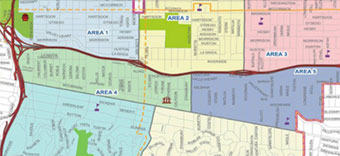
SHERMAN OAKS COMMUNITY
GEOGRAPHIC AREA BOUNDARIES
(each containing roughly equal stakeholder populations)
Area 1 Bounded by: Burbank Boulevard (N)*
101 Freeway(S)
Van Nuys Boulevard (E)
405 Freeway (W)
Area 2 Bounded by: Burbank Boulevard (N)*
101 Freeway(S)
Woodman Avenue (E)
Van Nuys Boulevard (W)
Area 3 Bounded by: Burbank Boulevard (N)
101 Freeway(S)
Coldwater Canyon Boulevard (E)
 Woodman Avenue (W)
Area 4 Bounded by: 101 Freeway (N)
Ventura Boulevard (S)
Hazeltine Avenue (E)
405 Freeway (W)
Area 5 Bounded by: 101 Freeway (N)
Ventura Boulevard (S)
91423-91604 Border (E) **
Hazeltine Avenue (W)
Area 6 Bounded by: Ventura Boulevard (N)
Mulholland Drive (S)
Beverly Glen (E)
405 Freeway (W)
Area 7 Bounded by: Ventura Boulevard (N)
Mulholland Drive (S)
91423-91604 border (E) **
Beverly Glen (W)
 
* The commercial corridor of Van Nuys Boulevard between Burbank and Magnolia is excluded from the Sherman Oaks community area.
** See Article III
 
209243.5


* The northern boundary shall be Burbank Boulevard except for the commercial corridor on Van Nuys Boulevard between Burbank Boulevard and Magnolia Boulevard.
* The boundary on the east follows Coldwater Canyon south from Burbank Boulevard, where it follows the border between zip code 91604 and 91423 (Coldwater Canyon Avenue south to Kling Street, west to Van Noord Avenue, south to Sarah Street west to the Avenue south to Valleyheart Drive west to Fulton Avenue south to Ventura BL east to Longridge Avenue south to the southern terminus of Longridge Avenue, and then a sight line from the southern terminus of Longridge Avenue to the intersection of Split Rock Road and Mulholland Drive.

Download Adobe Acrobat PDF of Bylaws (72k)

© Copyright 2012 Sherman Oaks Neighborhood Council. All Rights Reserved.